
The Picasso Museum Málaga is not what most visitors expect. It’s not the Guernica. It’s something more intimate, more personal and more surprising.
I live here. The Picasso Museum Málaga is the cultural centrepiece of the city — housed in a 16th-century Renaissance palace, built over Phoenician walls, and containing a collection donated by Picasso’s own family. This guide tells you what’s actually inside, how to get in for free, and the secret garden that almost nobody finds.
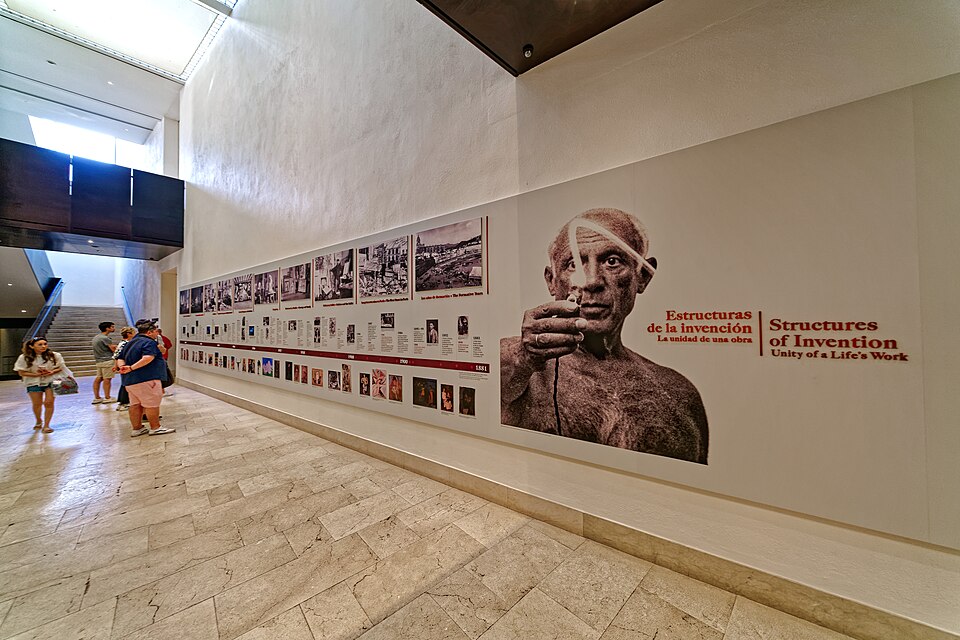
Picasso Museum Málaga — what to expect
01 — The Renaissance palace that surprises every visitor
Most international visitors to the Picasso Museum Málaga arrive expecting white walls and contemporary gallery spaces. What they find is a 16th-century Renaissance palace — the Palacio de los Condes de Buenavista — with a beautiful central courtyard of Andalusian columns, Mudéjar coffered ceilings and stone archways. The contrast between the ancient building and the 20th-century art inside it is part of what makes the museum distinctive.
02 — The Phoenician walls beneath your feet
The real surprise comes when you descend to the basement. During the palace’s rehabilitation, archaeologists discovered remains of the Phoenician city wall of Málaga dating to the 7th century BC, Roman fish-salting factories and Nasrid-era rooms. The Picasso Museum Málaga displays these archaeological remains in situ — you walk through 2,700 years of the city’s history on your way to view 20th-century paintings. It’s one of the most disorienting and wonderful aspects of the museum and almost nobody mentions it.
The Picasso Museum Málaga collection — what’s actually there
03 — The intimate family collection
The Picasso Museum Málaga’s collection comes primarily from donations by Christine and Bernard Ruiz-Picasso — Picasso’s daughter-in-law and grandson. This means the collection is deeply personal and intimate rather than monumental. If you’re expecting the Guernica (Museo Reina Sofía, Madrid) or Les Demoiselles d’Avignon (MoMA, New York), you won’t find them here. What you will find is the private Picasso — the experiments he made for himself, the portraits of his wives and children, the ceramics he produced for pleasure.
The collection spans his entire career chronologically and thematically, covering every major period of his work.
04 — Key works in the permanent collection
- Olga Jójlova con mantilla (1917) — A portrait of his first wife, the Russian ballerina, painted in Barcelona in a classical realist style that breaks entirely with the expectation of cubism. One of the most technically accomplished works in the museum.
- Madre y niño (1921–22) — Neoclassical period. Monumental, tender, with extraordinary volume and weight. One of the most immediately affecting works in the collection.
- Busto de mujer — Jacqueline (1960) — Portrait of his last wife and muse, showing the late Picasso combining frontal and profile perspectives in a single face. A perfect example of his mature language.
- Niño con una pala (1971) — Painted near the end of his life, evoking the freshness of children’s drawing with absolute technical mastery. One of his most moving late works.
- Ceramics and bronzes — The three-dimensional pieces in the Picasso Museum Málaga demonstrate that his genius was never confined to the canvas. The ceramics in particular are playful, technically extraordinary and rarely discussed.
05 — Temporary exhibitions — worth the extra cost
The Picasso Museum Málaga has one of the strongest exhibition programmes and international loan networks of any museum in Spain. Temporary exhibitions regularly bring masterworks from the Centre Pompidou, the Musée Picasso Paris and major international collections — works that rarely appear in Spain. The combined ticket costs only a few euros more than the permanent collection alone. Almost always worth it.
Picasso Museum Málaga — tickets, prices and hours
| Ticket | Price | Notes |
|---|---|---|
| Permanent collection | €10 | Includes audioguide app |
| Temporary exhibition | €8 | — |
| Combined (permanent + temporary) | €13 | Best value — recommended |
| Reduced (65+, students under 26) | €5 | Physical accreditation required |
| Under 16 / disabled visitors | Free | — |
| Sunday last 2 hours | Free | See below |
06 — Free entry — the Sunday trick
Free entry every Sunday
- Free entry during the last two hours of opening every Sunday
- Winter (closes 6pm): free from 4:00pm
- Summer (closes 7pm): free from 5:00pm
- Free tickets cannot be reserved online — collect at the physical ticket desk
- Arrive 20 minutes before the free window opens — capacity is limited
- Book tickets in advance for other days at museopicassomalaga.org
07 — When to visit
The Picasso Museum Málaga takes 90 minutes to 2 hours at a comfortable pace. The rooms are organised chronologically through the major periods of his career — Blue Period, Rose Period, Cubism, Neoclassicism, late work. The flow is logical and unhurried.
Best timing: morning visits before noon, or from 4pm onwards when organised tour groups have typically left. Cruise ship days bring large groups — check if a ship is in port before planning your visit. Avoid 11am–1:30pm on weekends in summer.
What most guides don’t tell you about the Picasso Museum Málaga
08 — The secret garden café
Most visitors finish the museum, pass through the gift shop and leave. Almost nobody finds the museum’s café, located in the rear courtyard garden of the palace. It’s a corner of complete silence in the middle of the historic centre — orange trees, jasmine and vines growing around Renaissance stone, completely isolated from the noise of the surrounding streets.
The museum maintains a small urban herb garden here, inspired by the Mediterranean gardens that Picasso missed during his years of exile in France. It’s the most peaceful place in central Málaga for a coffee after the visit — and virtually nobody knows it exists. Walk through the museum to the back of the building and find it.
The Picasso Trail in Málaga — a one-hour walking route
After the museum, extend the experience with a walk through the places that shaped Picasso’s childhood in Málaga. The entire route takes about one hour on foot.
09 — Casa Natal Picasso — his birthplace
Plaza de la Merced 15 — the building where Pablo Picasso was born on 25 October 1881. Now the headquarters of the Fundación Casa Natal, it contains family objects, childhood memories, original lithographs and a faithful recreation of the 19th-century living room where the young Pablo watched his father paint. His father, José Ruiz Blasco, was a drawing teacher — the first person to recognise and nurture his talent.
10 — The Picasso bench — Plaza de la Merced
Directly opposite the Casa Natal, a life-size bronze sculpture of Picasso sits on a stone bench in the square — holding a sketchbook and pencil, surrounded by the pigeons he drew obsessively as a child. Sit next to him for the photograph. It’s a Málaga classic and completely free.
11 — Iglesia de Santiago Apóstol — where he was baptised
Calle Granada 78 — the oldest church in Málaga, built over a mosque after the 1487 Reconquista, with an imposing Mudéjar tower. Inside is the original marble baptismal font where Pablo Picasso was baptised on 10 November 1881 under the full traditional name: Pablo Diego José Francisco de Paula Juan Nepomuceno María de los Remedios Cipriano de la Santísima Trinidad Ruiz y Picasso. Worth stepping inside for five minutes.
My honest recommendation for the Picasso Museum Málaga
Buy the combined ticket. Arrive at 10am on a weekday or at 4pm on a Sunday for free entry. Spend 20 minutes in the basement with the Phoenician walls before going upstairs. Find Olga Jójlova con mantilla and spend five minutes with it. End in the secret garden café with an espresso under the orange trees.
The Picasso Museum Málaga is not the greatest Picasso collection in the world — the Reina Sofía in Madrid and the Musée Picasso in Paris hold more famous works. But it’s the most personal, the most intimate and the only one housed in the city where he was born. That context changes how you look at everything inside it. For more on what to see in Málaga, see our complete guide to things to do in Málaga and our guide to the Cathedral.