
The Feria de Málaga is the most open, accessible and joyful major fair in Andalusia. And most tourists arrive without understanding how it actually works.
I live here. The Feria de Málaga is nine days of continuous celebration in August — and it’s genuinely unlike any other fair in Spain. This guide explains the most important thing most guides miss: the Feria de Málaga is actually two completely separate fairs happening simultaneously, and knowing the difference changes your entire experience.
Feria de Málaga — dates and duration
01 — When the Feria de Málaga takes place
The Feria de Málaga takes place every year in mid-August and lasts nine days. The dates are fixed around 19 August — the anniversary of Málaga’s incorporation into the Crown of Castile when the Catholic Monarchs entered the city on 19 August 1487. The fair always includes that date.
The official opening is at midnight on the Friday before the first Saturday — a Pregón (official proclamation) followed by a mass fireworks and drone show over La Malagueta beach and the port, which draws hundreds of thousands of people to the seafront. It’s one of the most spectacular free spectacles in southern Spain and the moment the city’s energy shifts completely.
The Feria de Málaga — two completely different fairs
The most important thing to understand about the Feria de Málaga is that it operates in two separate locations with two completely different atmospheres. Most tourists don’t realise this and miss half the experience.
02 — The Day Fair — Feria de Día in the historic centre
Hours: 12:00pm to 6:00pm
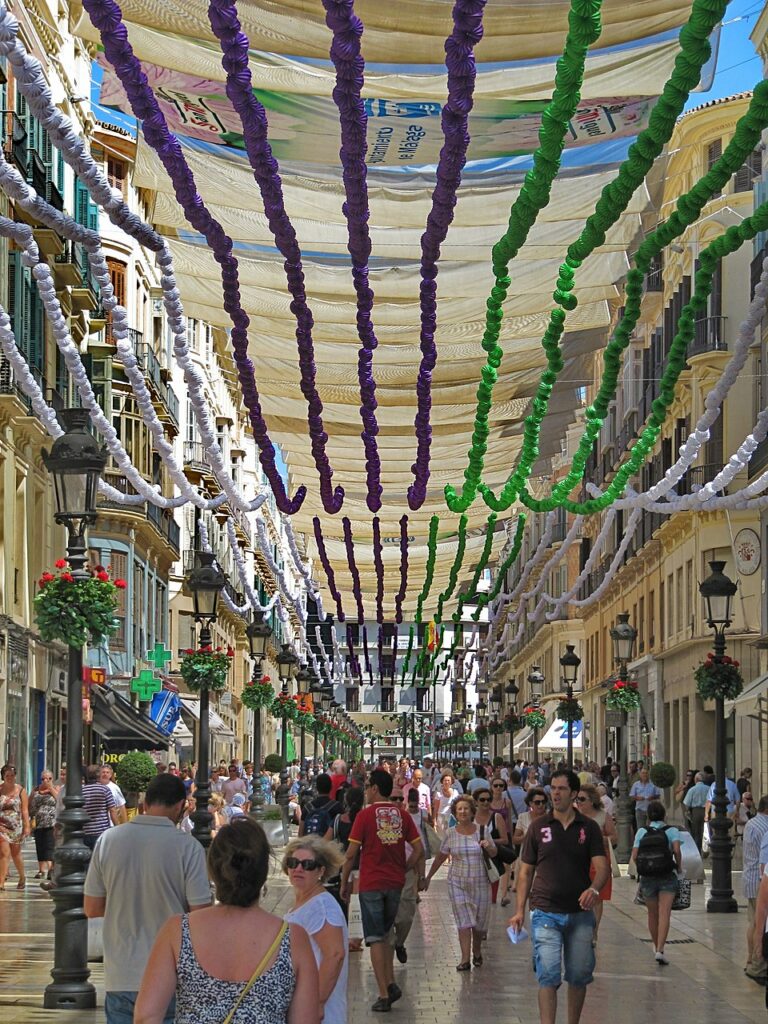
During the day, the Feria de Málaga takes over the historic centre. Calle Larios and the surrounding streets are decorated with enormous awnings, paper lanterns and bunting. People dance in the street, live music plays on every corner — flamenco, pop, reggaeton — and everyone drinks Cartojal: the local sweet wine, served ice-cold in bright pink bottles with small magnetic plastic glasses that people hang around their necks. It’s loud, euphoric, colourful and completely accessible to anyone.
The day fair is where you’ll see the verdiales — see below — and where the street energy of the Feria de Málaga is at its most intense and spontaneous. You don’t need a ticket or an invitation for anything. You walk in, find a spot, order a Cartojal and join the city.
03 — The Night Fair — Real de la Feria at Cortijo de Torres
Hours: Open from midday, peak from 9:00pm until dawn
At night, the Feria de Málaga moves to the Cortijo de Torres fairground on the western edge of the city. This is a vast, purpose-built fair site — the spectacular illuminated Portada entrance arch lit by thousands of bulbs, mechanical attractions, horse-drawn carriages moving between the streets, and over 200 casetas lining the avenues. Women dress in flamenco dresses, the smell of cotton candy and churros fills the air, and the energy builds progressively from 9pm until the fair closes at dawn.
How the casetas work — and why Málaga is different from Sevilla
04 — Almost all casetas are free and open to everyone
This is the crucial difference between the Feria de Málaga and the Feria de Abril de Sevilla, which is 95% private casetas requiring a personal invitation from a member. At the Feria de Málaga, the vast majority of casetas are completely public — any visitor can walk in freely, order food and drink, and join the dancing.
The casetas range from traditional flamenco peñas to political party tents to neighbourhood associations to nightclub-style spaces with DJs. Nobody checks who you are. You walk in, find a table, order pinchitos and a jug of Rebujito, and you’re part of the Feria de Málaga. This openness is what makes it the most accessible major fair in Andalusia.
The verdiales — the ancient music of the Feria de Málaga
05 — The oldest living folk music tradition in Europe
Visitors expecting sevillanas at the Feria de Málaga will find something far more ancient. The verdiales are a primitive variant of flamenco — considered a genuine musical fossil that has survived intact in the villages of the Axarquía and the Montes de Málaga for centuries. They predate commercial flamenco and sound completely different from it.
The Pandillas de Verdiales play guitars, enormous tambourines, lutes and cymbals. Their most distinctive feature is their extraordinary hats: wide straw brims covered in hundreds of fabric flowers, coloured ribbons and small mirrors — the mirrors originally intended to ward off evil spirits by reflecting sunlight. During the day fair, dedicated stages — particularly at Plaza de las Flores — host competing pandillas for hours. It’s hypnotic, visually extraordinary and one of the most genuine cultural experiences available at the Feria de Málaga.
What to drink and eat at the Feria de Málaga
06 — Cartojal — the official drink of the day fair
Cartojal is the liquid symbol of the Feria de Málaga — a sweet wine with Denominación de Origen Málaga Virgen, made from Moscatel grapes, sold in unmistakable bright pink bottles. Drunk from small magnetic plastic glasses that people hang around their necks as a Feria accessory. The rule: it must be drunk ice-cold. If it warms up it becomes cloying and the next morning will be unpleasant. Keep it cold, drink it slowly.
07 — Rebujito — the drink of the night fair
At the Real, the drink of choice is Rebujito — Manzanilla or Fino sherry mixed with lime soda (Sprite or similar) over crushed ice, served by the jug. Extremely refreshing, tastes like almost nothing, and that’s exactly its danger. Drink slowly and alternate with water. At 32°C in August, dehydration and alcohol combine faster than you expect.
08 — What to order in the casetas
- Pinchitos morunos — spiced pork or chicken skewers grilled over charcoal. Cheap, fast, universally liked.
- Porra antequerana — the cold thick soup of Málaga province. Perfect for cooling down at midday.
- Jamón ibérico and Manchego cheese — the fuel for a long night of dancing.
- Fritura malagueña — plates of fried boquerones, calamari or cazón. The seafood of the fair.
Getting around during the Feria de Málaga
09 — Línea F — the 24-hour fair bus
Do not drive during the Feria de Málaga. The historic centre is completely closed to traffic and parking at the Real is impossible. The EMT bus company operates a special fair service running 24 hours a day for the entire nine days.
Línea F connects the Day Fair centre (main stop at Parque de Málaga, near Plaza de la Marina) directly with the Real de la Feria at Cortijo de Torres. Runs continuously — you can take it at 10pm to go to the fair or at 6am to come back. Free or heavily subsidised during the fair period — check current information at emtmalaga.es.
If you’re staying outside the centre — in Huelin, El Palo, Teatinos — look for buses prefixed with F (F1, F2, etc.) running directly from your neighbourhood to the Real without going through the centre.
10 — The metro — fastest option to the Real
The metro extends its late-night hours during the Feria de Málaga. Take Line 1 or 2 from Atarazanas or Guadalmedina and get off at Palacio de Deportes station — 8 minutes’ walk from the Real entrance following the crowd. Faster than the bus at peak times and avoids surface traffic completely.
11 — Taxis and apps — use with caution at peak hours
Taxis have fixed fair tariffs displayed inside the vehicle — legitimate and regulated, but queues at peak hours (6pm when the day fair closes, 3am when the Real is in full swing) can exceed 30 minutes. Uber and Bolt operate normally but surge pricing activates heavily during the Feria de Málaga — always check the price before confirming.
What nobody tells you about the Feria de Málaga
12 — The 6pm cut — the moment that confuses every tourist
At exactly 6:00pm during the Feria de Málaga, the music in the historic centre stops abruptly by municipal order. Simultaneously, council cleaning trucks move in with water jets to wash the streets clean of spilled wine. The transformation takes about 20 minutes — the fair street becomes a wet, quiet, ordinary city street.
Tourists who don’t know this happens are invariably confused — standing in a suddenly silent, wet street with no idea where the party went. The local solution: use the 6pm to 9pm window to return to your hotel, shower, change out of the daytime fair clothes and prepare for the Real. The transition from day fair to night fair requires a change of gear — literally and figuratively. The night fair is more elegant, more traditional and more spectacular than the day fair, and arriving fresh makes the difference.
My honest recommendation for the Feria de Málaga
Arrive at the day fair by 1pm. Find the verdiales stage and watch a pandilla perform. Drink Cartojal cold and slowly. At 6pm, go back to your hotel and rest. At 9:30pm, take the Línea F bus or the metro to the Real. Walk in through the illuminated Portada. Find a public caseta, order pinchitos and Rebujito and stay until you can’t anymore.
The Feria de Málaga is nine days of the city at its most itself — generous, loud, open and genuinely joyful. If it coincides with your visit, rearrange everything else around it. For more on planning your trip, see our guide on the best time to visit Málaga and our transport guide.