
Málaga has two street art scenes — one institutional and spectacular, one spontaneous and rebellious. Both are worth your time.
I live here. Málaga street art has transformed two of the city’s most neglected neighbourhoods into some of the most visually compelling urban spaces in Spain. This guide covers the MAUS project in Soho, the raw community art of Lagunillas, the artists you need to know, and the hidden ceramic Space Invaders that most visitors walk straight past.
The MAUS project now has a downloadable map of all official murals available at malagaturismo.com — useful for planning your route before you go.
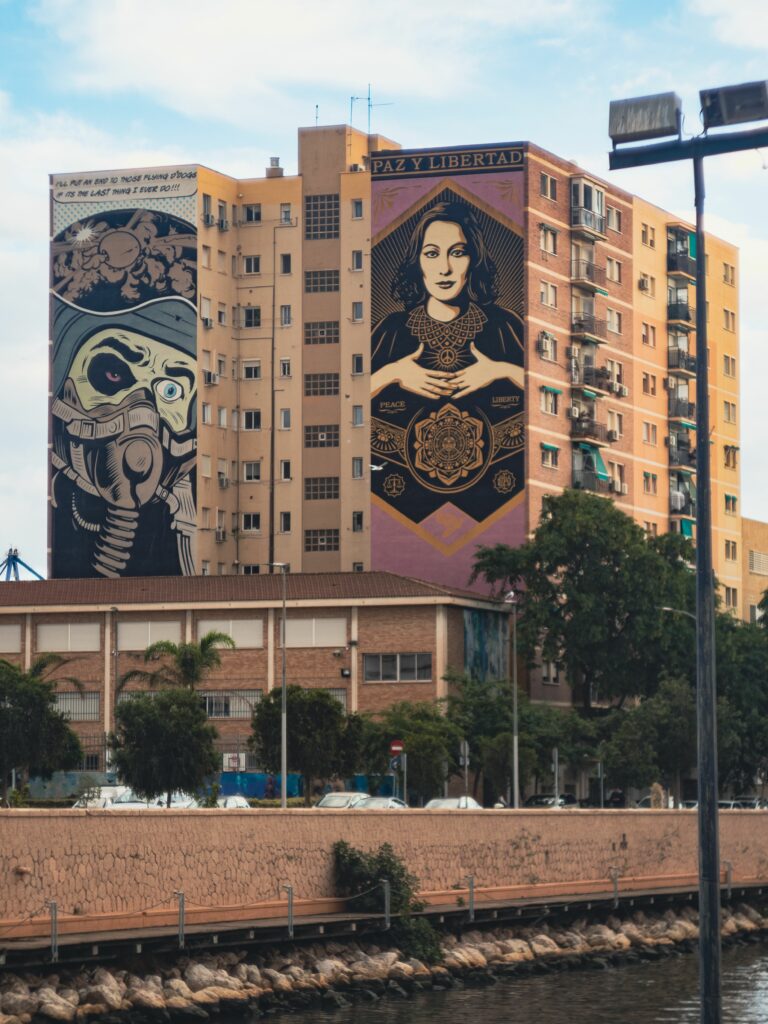
Málaga street art — the MAUS project and how it started
01 — How a neglected neighbourhood became a world-class outdoor gallery
In the early 2000s, the area between the port and the Alameda Principal — now known as Soho — was one of the most depressed zones in central Málaga. Empty commercial premises, abandoned buildings, significant social problems. Residents and local businesses pushed for change.
The Málaga city council responded with the MAUS project — Málaga Arte Urbano Soho — a comprehensive regeneration plan that invited some of the most significant street artists in the world to use the blank ten-storey residential building facades as giant canvases. The neighbourhood was pedestrianised, filled with independent cafés, design studios and galleries, and rebranded as the Soho of Málaga. The transformation is one of the most successful examples of art-led urban regeneration in Europe.
The artists behind Málaga street art
02 — Obey (Shepard Fairey)
The American artist who created the iconic Barack Obama Hope poster and the Obey Giant brand. His Málaga street art contribution in Soho is a monumental mural showing a woman’s face surrounded by floral and geometric motifs in red, black and cream — a message of empowerment and peace on the scale of an entire building facade. One of the most photographed pieces of Málaga street art.
03 — D*Face
One of the most significant names in British street art — a pop-art satirical style drawn from classic comics, skate culture and skull imagery. His Málaga street art mural shows a vintage comic-style pilot in freefall, painted directly adjacent to the Obey mural. The visual competition between the two massive facades — Obey vs D*Face, side by side — is one of the most powerful urban compositions in Spain.
04 — ROA
The Belgian artist known worldwide for painting enormous monochromatic animals on building facades, adapting each work to the architecture of its surface. His Málaga street art contribution — a giant field rat lying on its back on a wall facing the Guadalmedina river — is raw, hyperrealistic and fascinatingly detailed. The level of fur texture at that scale is extraordinary.
05 — Dadi Dreucol — the local pride
The most significant Malagueño artist in the street art scene. His recurring character — a bearded, semi-naked man walking through the city — reflects on the relationship between the human body and urban space. His work appears across both Soho and the Guadalmedina riverbanks, and his camouflage-painted chameleon alongside ROA’s rat on the CAC wall is one of the best double-acts in Málaga street art.
Soho vs Lagunillas — two completely different Málaga street art scenes
06 — Soho — institutional, monumental, spectacular
The Soho MAUS murals are funded, permitted and produced with scaffolding and cherry pickers. The artists were commissioned, paid and given entire building facades to work on. The results are spectacular — technically extraordinary works at a scale that few cities can match. But it’s institutional street art: planned, approved and curated. The spontaneity of traditional graffiti is replaced by the ambition of contemporary mural painting.
07 — Lagunillas — spontaneous, political, alive
On the other side of the historic centre, north of Plaza de la Merced, Lagunillas is a working-class neighbourhood under intense gentrification pressure. The street art here emerged with no public funding and no institutional permission — local artists painting collapsed walls, empty lots and workshop metal doors to protest against tourist rental speculation, to honour deceased neighbours and to celebrate flamenco culture.
The atmosphere change between Soho and Lagunillas is immediate and complete. Soho has coffee shops and design studios. Lagunillas has neighbourhood bars where locals argue football. The art reflects this: colourful, chaotic, rustic, politically charged and constantly evolving as new pieces appear over old ones. It’s the most authentic Málaga street art scene — and the least visited by tourists.
What most guides don’t tell you about Málaga street art
08 — The hidden Space Invaders of Málaga
The mysterious French artist Invader — who installs ceramic tile mosaics based on the classic 1980s Space Invaders video game on buildings across the world — visited Málaga and left dozens of small pixelated alien mosaics hidden across the historic centre. They appear on street sign poles, cornerstones, monuments and building facades — always at eye level or just above, always in unexpected places.
While everyone else is looking at the large Soho murals, the best game for a curious traveller is to walk through the historic centre looking slightly higher than normal — at the street signs, at the building corners — hunting for the small ceramic aliens. It turns an afternoon walk into something genuinely engaging. Once you see your first one, you’ll start finding them everywhere.
Málaga street art route — 2.5 hours on foot
| Time | Stop | What to see |
|---|---|---|
| 10:00am | CAC Málaga exterior — riverside | ROA’s giant rat + Dadi Dreucol’s chameleon on the river walls |
| 10:30am | Calle Comandante Benítez — Soho | Obey and D*Face murals side by side — the centrepiece of MAUS |
| 11:15am | Soho side streets | Hunt for Invader Space Invader mosaics on street sign poles and corners |
| 11:45am | Coffee at Santa Canela — Soho | One of the best speciality coffees in Málaga |
| 12:15pm | Walk north through historic centre | Past Plaza de la Merced — see the Picasso bronze bench |
| 12:30pm | Lagunillas — Calle Lagunillas and Calle Cruz Verde | Community murals, political art, neighbourhood portraits |
| 1:15pm | La Casa Invisible — cultural centre | 19th-century building with hidden Andalusian courtyard — tea or craft beer |
Where to stop on the Málaga street art route
09 — Santa Canela — Soho’s pioneering speciality coffee
One of the first independent cafés to open in Soho during the neighbourhood’s transformation. Industrial aesthetic, shared wooden tables, designers working on laptops. Excellent single-origin coffee and sourdough sandwiches. The right place to rest mid-route in the Soho section.
10 — La Casa Invisible — the hidden cultural centre
A 19th-century building between the historic centre and Lagunillas — occupied, legalised and run as a citizen-managed cultural centre. Inside: a hidden Andalusian courtyard filled with plants, complete silence, a small alternative bookshop and a bar serving craft beer and homemade iced tea. The spirit of the space perfectly matches the Lagunillas street art scene — independent, community-run, outside the mainstream. One of the most surprising places in central Málaga.
My honest recommendation for Málaga street art
Start at the CAC riverside for ROA’s rat. Walk into Soho for the Obey and D*Face facades. Hunt for Space Invaders on the street sign poles as you walk. Coffee at Santa Canela. Then cross the historic centre to Lagunillas and spend an hour in a completely different world — rougher, more spontaneous, more alive. End at La Casa Invisible.
The Málaga street art scene rewards curiosity and slow walking. The best pieces are not always the biggest ones. For more on what to see in Málaga, see our complete guide to things to do in Málaga and our guide to staying in the Soho neighbourhood.