
Ronda is not just a pretty town. It’s a city suspended over a 100-metre abyss — and one of the most visually extraordinary places in Spain.
I live in Málaga. I’ve made this journey many times and I’ve watched tourists arrive at the Puente Nuevo, take a photograph and leave without seeing half of what makes Ronda extraordinary. This is the honest guide to a Ronda day trip from Málaga — how to get there, what to see, what nobody tells you about the bridge, and exactly where to stand for the photograph that every other guide gets wrong.
Getting to Ronda from Málaga — transport options and prices
| Option | Time | Cost | Notes |
|---|---|---|---|
| Train (María Zambrano → Ronda) | ~2 hours | €10–€15 each way | Check for possible bus transfers at Antequera |
| Bus (Damas — Estación de Autobuses) | ~2 hours | €8–€12 each way | Most reliable direct option |
| Car (A-397 via San Pedro) | ~1h 15min | Fuel only | Most scenic route — mountain road with coast views |
01 — The train — one of the most beautiful rail journeys in Andalusia
The train journey from Málaga to Ronda passes through the dramatic Desfiladero de los Gaitanes — the same gorge as the Caminito del Rey. Enormous limestone walls, hand-cut tunnels through the rock, wild olive and oak landscapes. The journey itself is worth the ticket. Take a window seat on the right side leaving Málaga.
Important warning: due to ongoing track modernisation works in the province, the direct Málaga–Ronda service may require a bus transfer at Antequera-Santa Ana, managed by Renfe. Always check current schedules before buying. Book at renfe.es.
02 — The bus — most reliable direct option
The Damas bus company operates direct services from Málaga bus station to Ronda without transfers. It’s the most straightforward public transport option for a Ronda day trip from Málaga. Check current timetables and book at damas-sa.es.
03 — By car — the most scenic option
The A-397 from San Pedro de Alcántara to Ronda is one of the most spectacular mountain roads in Andalusia — tight bends, pine forests and views of the Costa del Sol far below. If you’re renting a car in Málaga, this route adds significant value to the day. Parking in Ronda is available near the bullring and along the Paseo de Blas Infante.
The Puente Nuevo — what nobody tells you
04 — The bridge with a prison inside it
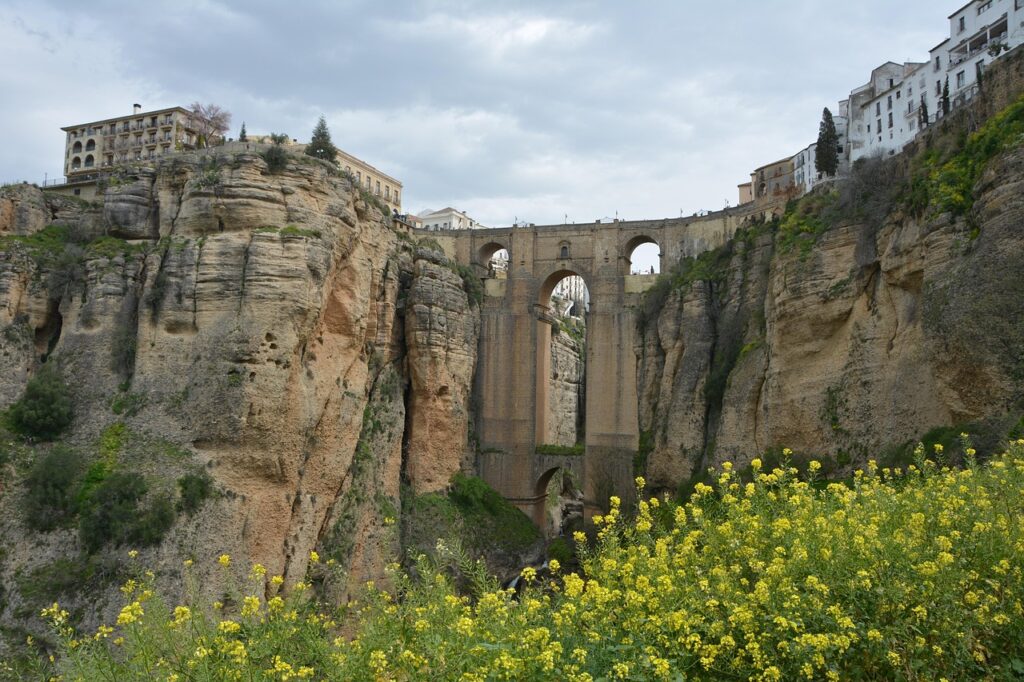
The Puente Nuevo — New Bridge — was completed in 1793 after 40 years of construction. It spans El Tajo de Ronda, a vertical gorge over 100 metres deep that splits the city into two halves: the Arab old town on one side and the newer commercial quarter on the other.
What 90% of guides don’t mention: look at the small window in the stone above the central arch. Inside that space is a room that functioned as a prison and place of torture during the Spanish Civil War. Prisoners from both sides of the conflict were held in this chamber suspended over the void, and according to local historical records, many were thrown from the bridge into the gorge below. Today the space houses a small interpretation centre about the bridge’s history — but walking across it knowing what is hidden inside gives the experience a completely different weight.
Puente Nuevo — practical info
- Free to cross at all times
- Interpretation centre inside: small entry fee
- Best time to visit: before 10am — the bridge is empty and the morning light on the gorge is extraordinary
- Vertigo warning: the views straight down from the bridge are genuinely vertiginous
What to see in Ronda beyond the bridge
05 — Casa del Rey Moro and the Water Mine
The palace gardens are spectacular — but the real reason to come is hidden underground. A staircase hand-cut into the gorge rock, with over 200 steps, descends to the bottom of El Tajo at river level. Built in the 14th century by the Moorish rulers to extract water during sieges — using Christian prisoners as a human chain — the descent makes you feel like you’re inside an adventure film. The view of the gorge walls from the bottom is overwhelming. The climb back up is hard. Take your time.
06 — Baños Árabes — the best-preserved Arab baths in Spain
Located in the old Jewish quarter below the bridge. Considered the best-preserved Arab baths on the entire Iberian Peninsula. The system of boilers, changing rooms and hot and cold pools survives intact, along with star-shaped skylights cut into the vaulted ceilings that filter light in shifting patterns throughout the day. A genuinely extraordinary piece of medieval engineering that most visitors to Ronda walk straight past.
07 — Plaza de Toros — the birthplace of modern bullfighting
Opened in 1785, the Plaza de Toros de la Real Maestranza de Caballería de Ronda is one of the oldest and most architecturally significant bullrings in the world. This is where the modern Rondean style of bullfighting was developed — a more austere, technical style than the Sevillian tradition. Whatever your views on bullfighting, the neoclassical sandstone architecture — the double gallery of columns, the proportions of the arena — is a remarkable building by any measure. Entry includes the museum. Check current prices at rmcr.org.
Where to photograph the Puente Nuevo — the three best spots
The best photographs of the Puente Nuevo are not taken from the bridge — they’re taken looking towards it. Here are the three locations that give you completely different perspectives.
08 — Mirador del Viento — the classic postcard shot
The most famous viewpoint and the one that produces the vertical shot of the bridge over the gorge that you see on every travel magazine cover. From the old town, find the small gated access near Plaza de María Auxiliadora where the Camino de los Molinos begins. A 10-15 minute downhill walk brings you to a natural platform with the full bridge directly in front of you.
If you’re driving, search Google Maps for “Arco de Cristo” or “Albergue Los Molinos” — a narrow forest track allows you to drive almost to the viewpoint and park nearby, avoiding the walk.
09 — Mirador de la Aldehuela — the hanging houses close-up
No walking required. Immediately after crossing the Puente Nuevo, turn left onto Calle Armiñán. A stone balcony built directly over the precipice gives you a dramatic close-up of the bridge terraces and the vertical drop below. Best for capturing the scale of the gorge and the houses built right to the edge. Less crowded than the Mirador del Viento.
10 — Jardines de Cuenca — the alternative angle
A series of terraced gardens built into the eastern wall of the gorge, on Calle Escolleras. From here you photograph the Puente Nuevo from the side — a less seen angle — with the older Puente Viejo and Puente de San Miguel visible below it. Less crowded than the main viewpoints and genuinely beautiful in the late afternoon light.
Ronda day trip from Málaga — the perfect one-day itinerary
| Time | Activity | Notes |
|---|---|---|
| 9:30am | Arrive — Mirador de los Viajeros Románticos | First panoramic view of the valley |
| 10:15am | Cross the Puente Nuevo | Stop in the middle and look down |
| 11:00am | Casa del Rey Moro — descend the Water Mine | 200+ steps down to the river |
| 12:30pm | Arab Baths | Best-preserved in Spain |
| 1:30pm | Lunch — rabo de toro at Restaurante Almocábar | Where locals eat |
| 3:30pm | Plaza Duquesa de Parcent + Santa María la Mayor | Most beautiful square in Ronda |
| 4:30pm | Walk to Mirador del Viento for the postcard photo | Best light in late afternoon |
| 6:00pm | Coffee and wine on Calle Espinel | Local D.O. Sierras de Málaga wine |
| 7:00pm | Return to Málaga | Check return train/bus times in advance |
11 — The most important timing advice
Arrive early — ideally by 9:30am. The Puente Nuevo at 9:30am is empty and the morning mist in the gorge is extraordinary. By midday, coaches from Seville, Marbella and the Costa del Sol fill the viewpoints and the bridge becomes crowded. The worst time to visit is between 12pm and 4pm on a weekend in summer.
You need 6 to 8 hours to see Ronda properly without rushing. A 4-hour visit means seeing the bridge and leaving — which means missing almost everything worth seeing.
Where to eat in Ronda
The dish to order in Ronda is rabo de toro — slow-braised oxtail, a mountain tradition that defines the local cuisine. Two honest recommendations:
- Restaurante Almocábar (Plaza Ruedo de San Francisco) — slightly off the tourist circuit, where locals actually eat. Exceptional oxtail and Iberian meats grilled over wood. The most reliable lunch option in Ronda.
- Bodega El Socorro (Calle Lorenzo Borrego) — more informal, excellent tapas. Order the oxtail croquettes or the rustic migas. Good local wines at honest prices.
My honest recommendation for a Ronda day trip from Málaga
Take the bus or train, arrive by 9:30am, descend the Water Mine before the crowds arrive, eat rabo de toro at Almocábar at 1:30pm, walk to the Mirador del Viento in the late afternoon for the photograph. Return to Málaga by 7pm.
Ronda is one of those places that rewards people who arrive early and stay long. Don’t make the mistake of treating it as a photo stop. Give it a full day and it will be one of the best days of your trip. For more day trip options from Málaga, see our complete day trips guide.